Posts

Showing posts from February, 2025

E - Love Does Encouragement

Image
Whether preschooler, teenager, or adult, we all thrive on encouragement. A few kind words can give us the push we need to overcome challenges, offer hope when we’re feeling discouraged, and shift our perspective in tough moments. For children, encouragement from loving adults isn’t just helpful—it’s transformative. It shapes how they see themselves, how they approach challenges, and how they build resilience for the future. Encouragement goes beyond words. A smile, a reassuring nod, or a simple thumbs-up can speak volumes. Quality time, meaningful conversations, and being present in their moments of joy and struggle all show children that we believe in them. When kids are succeeding, encouragement fuels their confidence to keep reaching higher. When they’re struggling, it reminds them they’re not alone. But perhaps most importantly, encouragement plants seeds of self-belief. Over time, our words and actions become the inner voice our children carry with them. A child who consistently h...

D - Love Does Discipline

Image
Love does discipline. As loving parents and teachers, we must be willing to discipline our kids. As discussed in the post on accountability, it's crucial that children grow up knowing that their choices matter and that there are consequences, good and bad, to decisions that they make. Disciplining children is a big part of this. But what, exactly, is discipline?  When they hear the word discipline, many think of punishment such as grounding, spanking, or losing privileges. While punishment is one aspect of discipline, it is far from the complete picture. Merriam-Webster defines discipline as “Control gained by enforcing obedience or order; self-control; punishment; training that corrects, molds or perfects the mental faculties or moral character.” On the other hand, Merriam-Webster defines punishment as “Suffering pain or loss that serves as retribution; a penalty inflicted on an offender through judicial procedure.” Perhaps the most significant difference between discipline and pu...

C - Love Does Communication

Image
Peggy O’Mara, an editor at  Mothering  magazine, said, “The way we talk to our children becomes their inner voice.”    This is a powerful statement to consider!  Positive relationships begin with positive two-way communication. These positive relationships, built on the foundation of good communication, are a critical piece in building a child’s self-concept. Children thrive on genuine encouragement and sincere praise. And when we, as loving parents and teachers, take time to truly listen to them, it creates in them a feeling of value. Using positive communication skills with our kids also provides them with an example of skills they will need to build successful relationships throughout their lives. So what does positive two-way communication look like? One aspect of positive communication is active listening. Active listening involves putting away distractions, resisting the urge to interrupt or lecture, and focusing on what your child is trying to say. Body l...

B - Love Does Big Feelings

Image
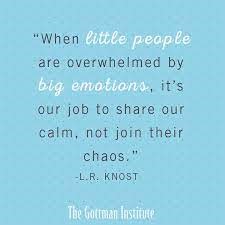
  “No!” “You can’t make me!” “I can’t do it!” “It’s never going to be ok!”  If these phrases sound familiar, you might have a young child in your life. Regulating emotions is a struggle for most young kids as they have yet to learn a constructive way to handle the big emotions they experience. Successful self-regulation can continue to elude children as they grow if they are not taught the skills needed to understand and manage their feelings. As loving parents and teachers, we are in a position to help our kids grow in their ability to self-regulate. It can be tempting to downplay their feelings - “It’s not that big of a deal” - or teach kids to hide their feelings - “Stop crying right now!” - instead of learning to manage them. Statements like these might have short-term success in stopping emotional behavior, but they don’t give children help with the skills they need to understand their feelings and practice healthy choices to show them.  An article on childmind.org (...

A - Love Does Accountability

Image
A n anonymous quote says, “Children who aren’t held accountable for their choices grow up to be adults who believe they can do nothing wrong.”    As loving parents and teachers, we want our kids to grow up knowing that their choices matter, that their actions can impact others, and that when they make mistakes - as we all do - there is usually a way to help make amends. It is natural for children to want to avoid consequences and pass the blame to others. Sometimes, we as adults even find ourselves tempted by these “easy out” behaviors. By setting consistent boundaries and enforcing appropriate limits, we provide our children a secure foundation from which to grow. According to an article on Parent.com (link below), teaching accountability means teaching kids to “right their wrongs, whether or not someone is watching.”  The article highlights 5 very key points to keep in mind when teaching accountability - 1 - be consistent  2 - allow kids to be responsible for their...

Love Does Intro

Image
  Love.  Lots of people have been thinking and talking about love as we come to the close of the month of February. We might love our spouse, our parents, our best friend, our kids, and mashed potatoes - each one evoking different feelings and actions. As an early childhood educator, and a mom of 3 (2 teens!) I spend a lot of time thinking about what love looks like in the teacher-child and parent-child relationship. A few years ago, a friend and fellow educator challenged me to write some of those thoughts down. I've always been a fan of an ABC format and thus Love Does ABCs was born. I first published this series in 2021 but this year felt like a great time to revisit, update, and republish. Whether you are a parent or an educator (or have any kids - or people at all! - in your life), hopefully you will find these posts encouraging and informative.   Check back tomorrow - March 1st! - for the first post: A - Love Does Accountability